An attribution setting is the rule Meta uses to decide which conversions an ad gets credit for: how long after a click, view or engagement a purchase still counts. Meta's current options are 1-day or 7-day click, 1-day view and 1-day engage-through, chosen per ad set.
An attribution setting is the rule Meta uses to decide which conversions an ad gets credit for: how long after a click, view or engagement a purchase still counts. Meta’s current options are 1-day or 7-day click, 1-day view and 1-day engage-through, chosen per ad set.
Which attribution settings does Meta offer?
3 standard ones: click-through within 1 or 7 days of a link click, view-through within 1 day of an impression, and engage-through within 1 day of any other click. You pick them at ad set level, under the standard attribution model.

Meta’s attribution page adds that engage-through also counts a video played for 5 seconds, or 97% of a shorter one. Each attribution setting is a mix of these: Meta’s API default, for instance, combines 7-day click with 1-day view. Besides the standard model, Meta offers incremental attribution, which predicts whether an ad caused a conversion, and custom attribution, which takes signals from your own analytics tool.
What does 7-day click, 1-day view mean?
A purchase counts if it came within 7 days of someone clicking the ad, or within 1 day of them seeing it without a click. Meta’s API reference names this pair as its default.
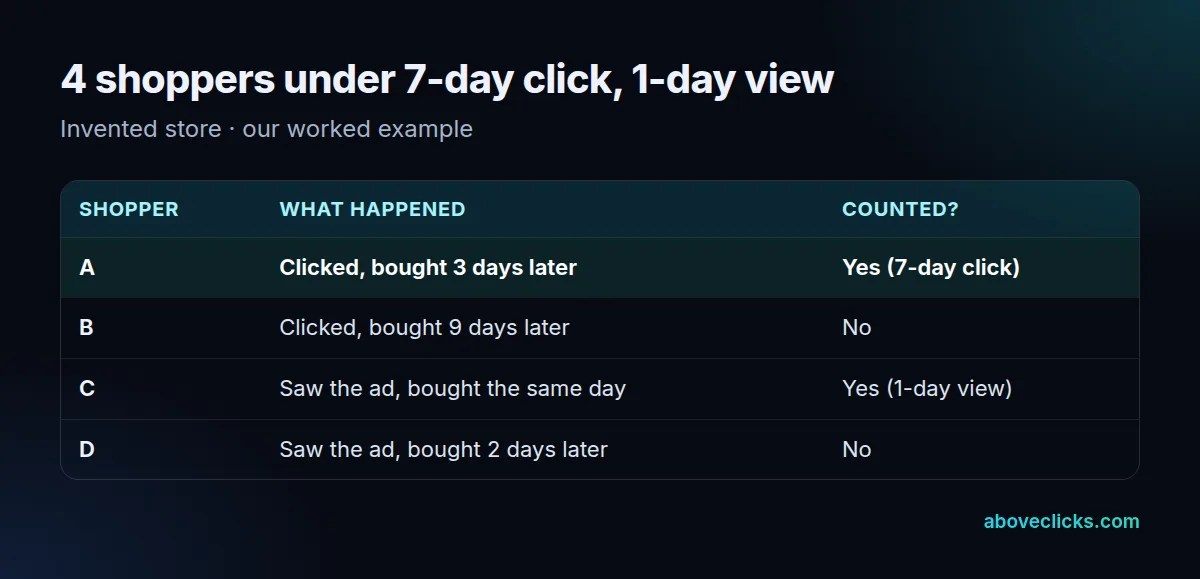
Our illustrative example has 4 shoppers. A clicks and buys 3 days later: counted. B clicks and buys 9 days later: not counted. C sees the ad and buys that day: counted, as a view through conversion. D sees it and buys 2 days later: not counted. Your store records all 4 orders, which is why store totals and Meta’s never match.
Is there still a 28-day attribution window?
Not in Meta’s Help Center, which lists only 1-day and 7-day click. On 18 October 2026, though, the Ads Insights API reference still accepted 24 window values, including 28-day click, 7-day view and 28-day view.
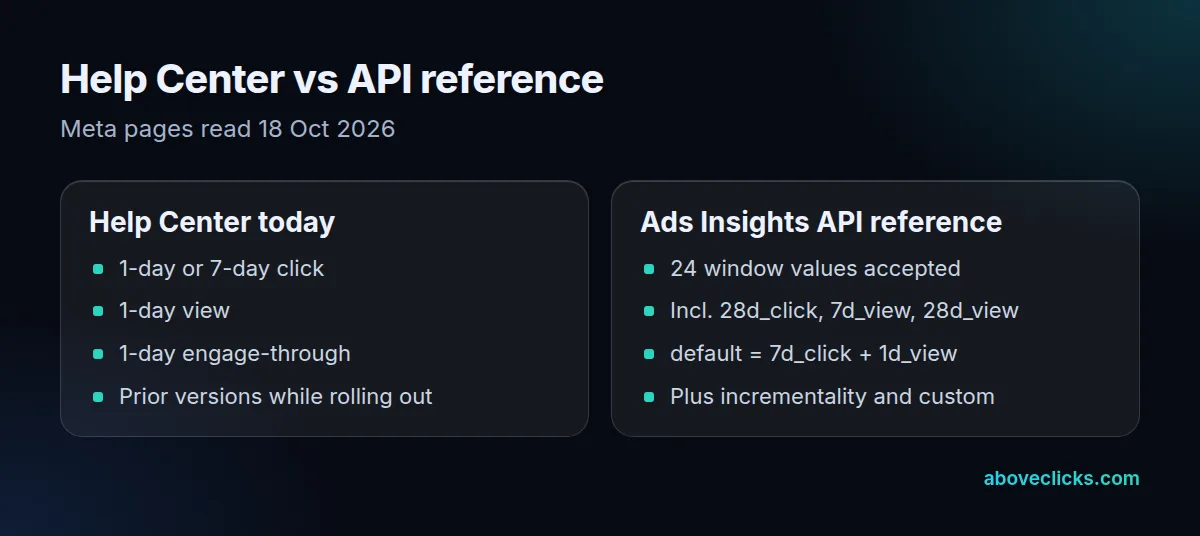
So older reports and third-party tools can still show 28-day figures, and Meta says some accounts may keep prior versions while the new settings roll out. App campaigns differ again: Meta’s Aggregated Event Measurement page says iOS 14 and later app campaigns using it get 1-day and 7-day click reporting. For your own decisions, use one attribution setting consistently and compare it with store orders. If a dashboard still shows 28-day click figures, check which attribution setting it requested before comparing it with Ads Manager, or you’ll be comparing different windows.
Does the setting change delivery?
Yes. Meta says standard attribution optimizes delivery for the time windows and behaviors you select, so it shapes who sees the ads, not just how results are counted.
That’s also why Meta warns against comparing ad sets that use different attribution models in the same table. For a hypothetical store, ad set X on 7-day click, 1-day view reports 140 purchases and ad set Y on 1-day click reports 110: X isn’t necessarily better. Use the Compare attribution settings feature to read both on the same terms, and see our attribution model and conversion window entries for the wider picture. Our Meta ads management team picks the attribution setting per account, and the Meta ads for e-commerce guide covers measurement. A practical start: keep the default on prospecting ad sets, and check a 7-day click column against store orders every month.