A Shopify custom app is an app built for one merchant's store, or for the stores of one Shopify Plus organization, not for every merchant. It uses the same APIs and extensions as a public app, skips Shopify's app review, and can't charge through Shopify's app billing system.
A Shopify custom app is an app built for one merchant’s store, or for the stores of one Shopify Plus organization, not for every merchant. It uses the same APIs and extensions as a public app, skips Shopify’s app review, and can’t charge through Shopify’s app billing system.
What is the difference between a custom app and a public app?
Reach and review. A public app installs on many stores and passes Shopify’s app review; a custom app installs on one store, or one Plus organization’s stores, needs no approval and can’t bill through Shopify.
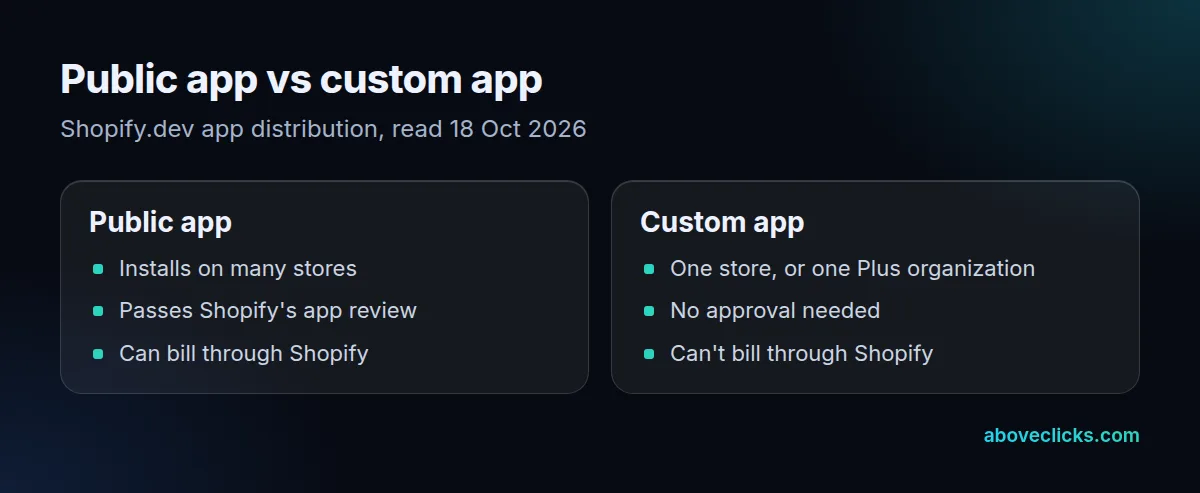
Shopify’s custom apps help page puts it plainly: “A custom app is an app that you or a developer builds exclusively for your Shopify store, unlike a public app that’s built for many stores to use.” The distribution guide adds a catch: you can’t change the distribution method after choosing it, so a custom app can’t later become a public one.
How common are they? On 18 October 2026 we read the checkout pages of 15 live Shopify stores. 7 of the 12 stores with checkout extensions loaded at least one from an app named after the brand itself, 41 of 144 extension entries. Nicobar’s checkout ran 15 of its 17 from one such app.

A brand name hints at an app built for that store, but the distribution type can’t be seen from outside, so read these as signs, not proof.
Are Shopify custom apps deprecated?
No, but the old way of making them is. Custom apps are now created in the Dev Dashboard; ones made in the Shopify admin before 1 January 2026 count as legacy apps, still work, and can’t be created any more.
The distribution guide lists the limits of those admin-made apps: no Shopify App Bridge in the admin and no app extensions, which rules out checkout UI extensions, theme app extensions and functions. An older type is gone entirely: private apps were deprecated in January 2022 and converted to custom apps on 20 January 2023.
How do you create a custom app in Shopify?
The store owner, or staff with the App development > Develop permission, creates it in the Dev Dashboard, installs it on the store and sets its API access. Collaborator accounts can’t use the Dev Dashboard.
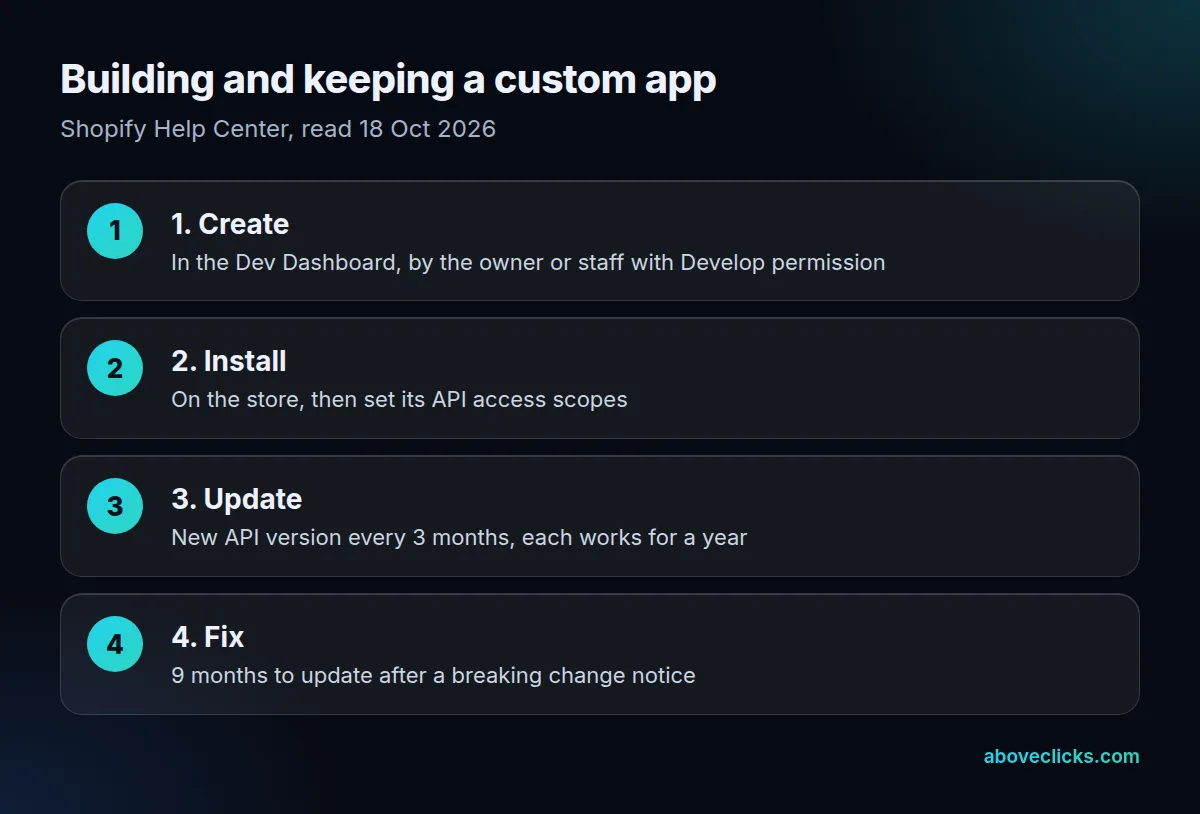
Two plan rules shape what you can build. Per the Function APIs reference, only Shopify Plus stores can run a custom app containing Shopify Functions, and checkout extensions on the information, shipping and payment steps also need Plus. Upkeep never stops: Shopify releases a new API version every three months, each works for a year, and after a breaking change the developer has 9 months to update before the app becomes unsupported.
Example (a hypothetical furniture store): it wants stock synced from its warehouse system every 15 minutes, and no public app reads that system. A custom app can do it with Admin API access only, so Plus isn’t needed. Budget for one version upgrade a year, since 4 releases a year each last 12 months. Our custom Shopify apps team builds and maintains apps like this, and our Shopify development service covers the store around them.