Repeat purchase rate is the share of customers who have placed 2 or more orders, out of all customers, measured over a stated time window. Shopify's closest built-in metric, returning customer rate, works differently: it divides returning customers by all customers who ordered in the period.
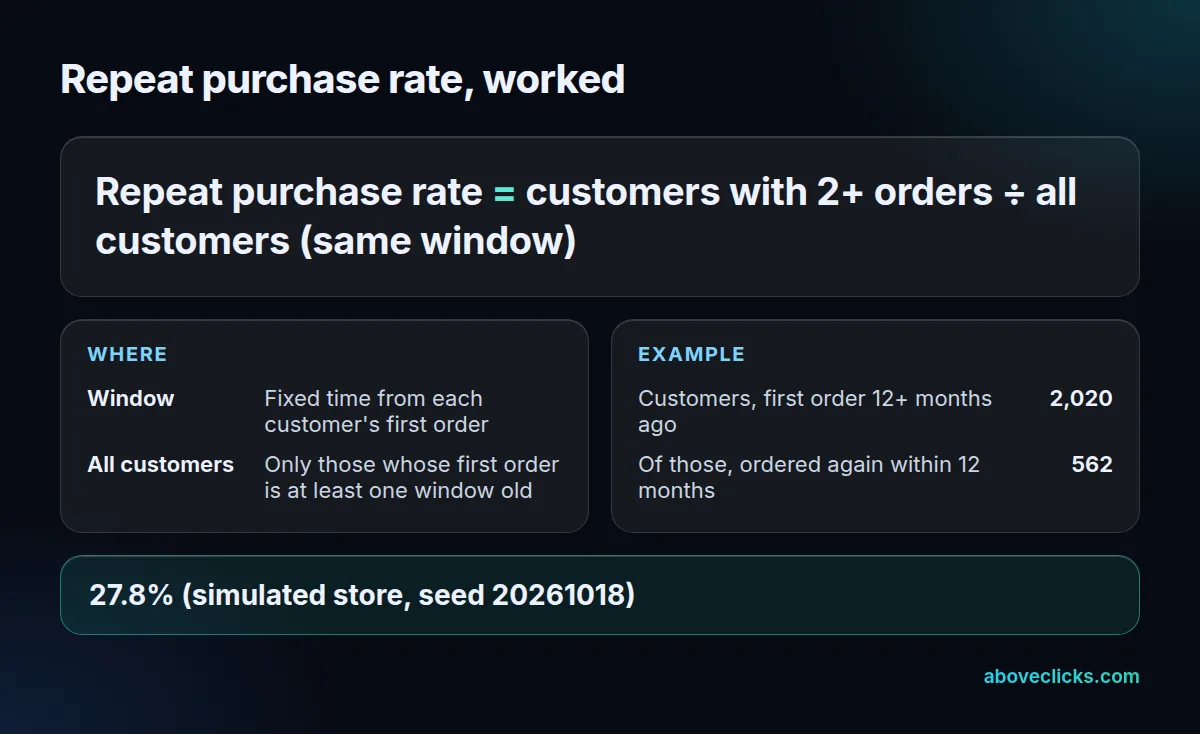
FormulaRepeat purchase rate = customers with 2+ orders ÷ all customers (same window)
Repeat purchase rate is the share of customers who have placed 2 or more orders, out of all customers, measured over a stated time window. Shopify’s closest built-in metric, returning customer rate, works differently: it divides returning customers by all customers who ordered in the period.
How do you calculate repeat purchase rate?
Divide customers with 2 or more orders by all customers, counting each customer’s orders within a fixed window from their first purchase. In our simulated store, 562 of 2,020 customers ordered again within 12 months: 27.8%.
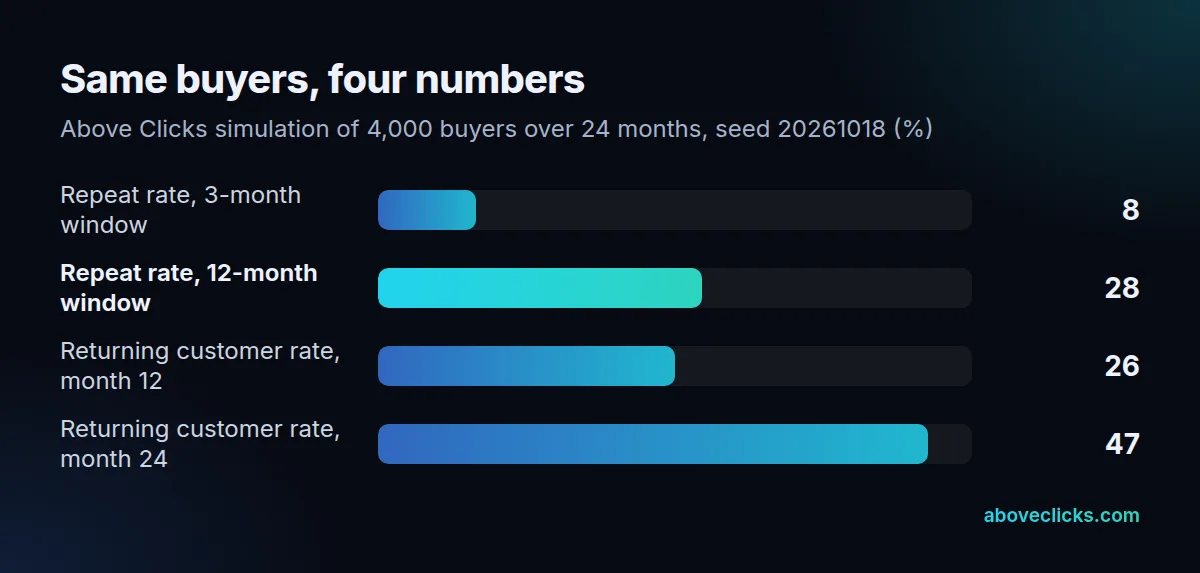
The window matters more than the formula. We simulated a hypothetical store with 4,000 first-time buyers spread over 24 months, each with a personal chance of coming back. The same customers read 8.4% with a 3-month window and 27.8% with a 12-month one. Leave out customers whose first order is younger than the window, or recent buyers who haven’t had time to return drag the number down.
State the window every time you quote the number. A loyalty app that reports “repeat purchase rate” may use all-time history, which for our simulated store read 25.4% (1,014 of 4,000 customers). That sits close to the 12-month figure only by chance; a store that sells mattresses and one that sells coffee would see very different gaps between the 3-month and all-time numbers.
Is repeat purchase rate the same as Shopify’s returning customer rate?
No. Shopify’s analytics fields reference defines returning customer rate as returning customers divided by customers who placed orders, adding: “Most stores display 20-40%.”
A returning customer is one whose order history already includes at least 1 order. So the returning customer rate describes this month’s buyers, while the repeat purchase rate describes a group of customers over time.
In our simulation, the Shopify-style rate was 25.5% in month 12 and 47.2% in month 24, though no one behaved differently: the store simply had more past buyers who could come back while new-customer numbers stayed flat. A rising returning customer rate can mean weaker acquisition as easily as better retention. Check it next to the count of new customers for the same months before you credit a loyalty campaign.
Where do you find it in Shopify?
Shopify has no field named repeat purchase rate, but its customers reports hold the inputs, starting with the Returning customers report: every customer with 2 or more orders.
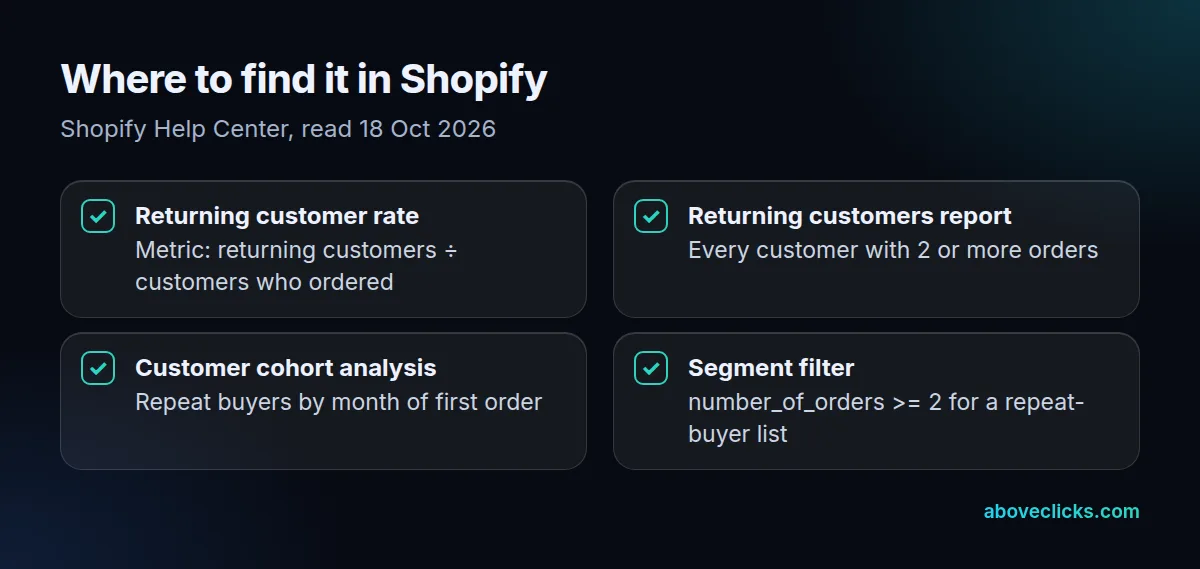
Customer reports use each customer’s entire order history, not only the selected dates. Shopify’s example: a November new customer still shows as a repeat customer in a November report if the second purchase came in December. The Customer cohort analysis groups customers by the month of their first order, and its spend projections need 24 months of data. To work with the repeat buyers themselves, Shopify’s segment filters include number_of_orders, so number_of_orders >= 2 builds the list.
Raising it
Look at the gap between first and second order before choosing a tactic. Our simulated buyers averaged 1.36 orders each, and most second orders came late, so a reminder timed to the usual repurchase gap beats a discount sent the day after the first order. Repeat buyers lift customer lifetime value without new ad spend, and the effect shows faster when average order value holds steady too.
Then split the rate by the product in the first order: if buyers who started with a sample pack come back far more often than those who started with a full-size item, that tells you what to put in front of new customers. Our loyalty programs service designs these rewards, and the CRO hub covers the rest.